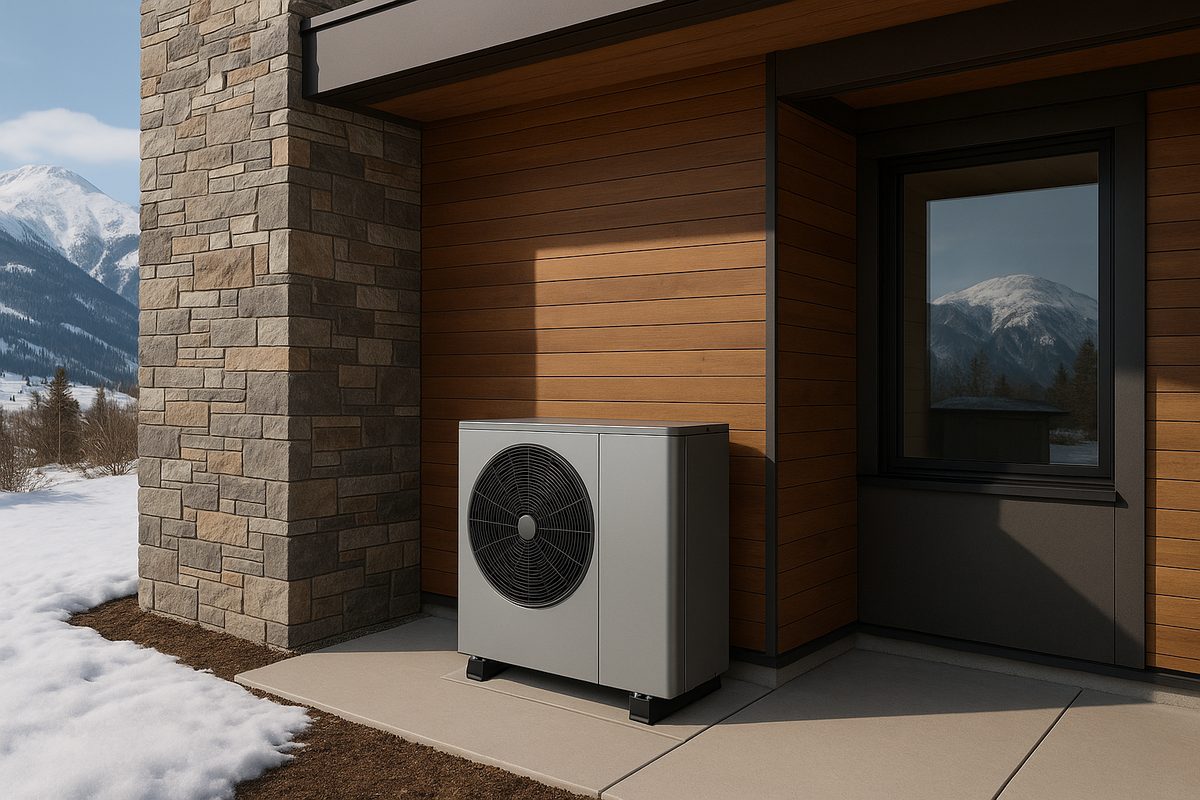
Why Kamloops Homeowners Are Asking About Heat Pumps
For decades, the standard Kamloops home heating setup was simple: a natural gas furnace for winter, a window air conditioner or central AC unit for the few really hot weeks in summer. That model is changing fast. Summers have gotten longer and hotter — 2021 broke records that have since been challenged in 2023 and 2024 — and natural gas prices in BC have climbed steadily. At the same time, federal and provincial rebates have made heat pumps dramatically more affordable than they used to be.
At Hodder Construction, heat pump questions now come up on almost every renovation and custom home consultation. Should you add one? Replace your existing AC with one? Go fully electric and ditch the gas furnace? The answer depends on your home, your timeline, and your budget — but the conversation is worth having for every Kamloops homeowner thinking about HVAC upgrades.
How Heat Pumps Actually Work
A heat pump is essentially an air conditioner that runs in both directions. In summer, it moves heat from inside your home to the outside — exactly like a conventional AC. In winter, it reverses and pulls heat from outside air (yes, even cold outside air contains heat energy) and moves it inside. Because it's moving heat rather than generating it through combustion, a heat pump can deliver three to four units of heat energy for every unit of electricity it consumes. That efficiency is what makes the operating costs competitive with natural gas in most months.
Two main configurations matter for Kamloops homes. Ducted central heat pumps replace or supplement your existing furnace and use the ductwork already in place. Ductless mini-split heat pumps mount individual indoor units in specific rooms or zones, fed by an outdoor compressor — useful for homes without ducting, for additions, or for zoning a problem area like a sun-baked upper floor.
How Heat Pumps Perform in Kamloops Winters
This is the question we get most often, and the honest answer is: better than people expect, with caveats. Kamloops winters are real — overnight lows of -15°C to -25°C aren't unusual in January — but they're milder than what people in Prince George or Edmonton deal with. Modern cold-climate heat pumps maintain full heating capacity down to about -15°C and continue producing usable heat well below that.
For most Kamloops homes, a properly sized cold-climate heat pump can handle 90–95% of annual heating needs on its own. The remaining cold snap days are typically covered by either a backup electric resistance element built into the air handler or by keeping the existing gas furnace as a dual-fuel backup. We generally recommend the dual-fuel setup for existing homes with functional furnaces — it keeps your heating bills predictable in extreme cold and provides redundancy if either system needs service.
What a Heat Pump Installation Costs in Kamloops in 2026
Installed costs vary widely based on home size, ductwork condition, and equipment tier, but here are realistic ranges for Kamloops in 2026:
- Ducted central heat pump (replacing existing AC, keeping furnace as backup): $14,000–$22,000. Most common scenario for existing Kamloops homes.
- Full dual-fuel system (new heat pump + new high-efficiency furnace): $18,000–$28,000. Good option if your furnace is also at end of life.
- Fully electric ducted system (heat pump + electric backup, no gas): $16,000–$26,000. Increasingly common in new builds and deep retrofits.
- Ductless mini-split (single zone): $5,000–$8,000. Per zone, with multi-zone systems adding incremental cost per indoor head.
Those are before rebates. Once you apply current federal and provincial incentives, the net cost drops significantly for many households.
The Rebate Landscape: What's Actually Available
BC has one of the most generous heat pump rebate programs in Canada through CleanBC and BC Hydro. Combined with federal incentives, eligible homeowners can recover $6,000–$11,000 of installation costs. The exact numbers shift as programs are updated, but the categories to ask your contractor about include:
- CleanBC Better Homes rebate for income-qualified and standard households.
- BC Hydro heat pump rebates stacked with CleanBC, often available for fuel-switching from gas to electric.
- Federal Greener Homes loan providing up to $40,000 in interest-free financing for energy-efficient upgrades (heat pumps qualify).
- City of Kamloops does not currently offer a separate municipal rebate, but utility-level programs apply throughout the region.
Rebates require working with a registered contractor and using qualifying equipment. They also require a pre- and post-installation energy assessment for some streams. Build that timing into your project plan — energy assessments can take a few weeks to schedule.
When a Heat Pump Makes the Most Sense
There are three situations where heat pumps are an obvious win for Kamloops homeowners. First, when your existing AC dies and you'd be replacing it anyway — the incremental cost to upgrade to a heat pump is much smaller than installing one from scratch. Second, during a major renovation or custom build when ductwork, electrical service, and mechanical layout are already on the table. Third, when you have no AC and are about to add one — for a small additional cost, you get year-round comfort and energy savings.
The cases where it's less obvious involve older homes with undersized electrical service (a 100-amp panel may need an upgrade to 200-amp), homes with poor insulation or air sealing (the heat pump will work harder than it should), and homes with very recent high-efficiency furnaces still under warranty. None of these are deal-breakers, but they affect the math.
What to Get Right Before You Install
A few things make the difference between a heat pump that performs well and one that disappoints. Right-sizing matters more than with gas furnaces — an oversized heat pump short-cycles and underperforms. Insist on a proper Manual J load calculation, not a rule-of-thumb sizing. Ductwork condition affects performance — leaky or undersized ducts can rob 20–30% of system efficiency. Air sealing and insulation should come first if your envelope is poor; a smaller, properly sized heat pump in a tight home outperforms an oversized one in a leaky home. Electrical service capacity needs verification, especially in older homes.
Working With Hodder on a Heat Pump Project
Hodder Construction coordinates HVAC upgrades as part of renovations, additions, and custom builds across Kamloops. We work with established local HVAC contractors who hold the required certifications for rebate-eligible installations, and we sequence the work so that envelope upgrades, electrical service changes, and equipment installation happen in the right order. If you're considering a heat pump as part of a larger renovation — or just want to understand whether it makes sense for your specific home — we're happy to walk through the options before you commit to anything. Get in touch at [hodder.ca/estimate](https://www.hodder.ca/estimate).